Someone asked me this week why our IPG LightWELD handle is heavier than some of the newer Chinese-built handheld lasers on the market. Fair question — here's the honest answer.
The Weight Is a Trade-Off, Not an Oversight
The lighter competitor handles get there by running the fibre cable straight into a sealed unit. Looks great on a spec sheet, until the optics get knocked in a busy shop — then the whole machine goes back to the manufacturer for weeks. LightWELD's handle is field-replaceable: damage it, swap it, keep welding the same day. That serviceability has to live somewhere, and it lives in the handle.
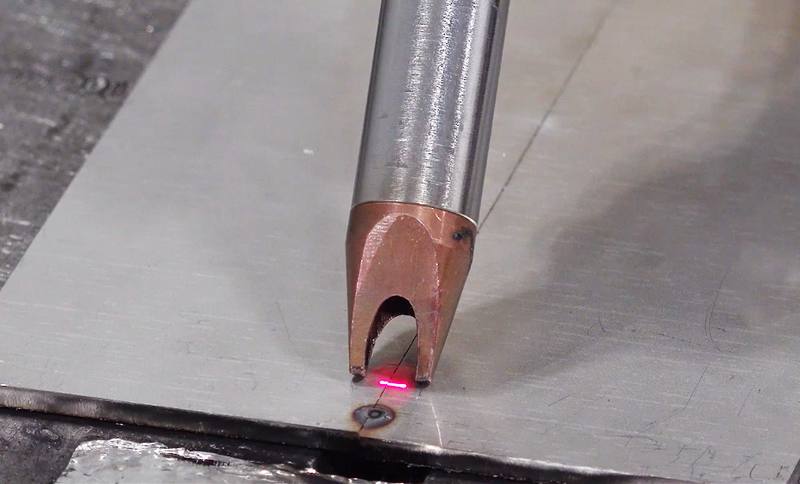
What's Actually Inside the Handle
It's also what's inside. LightWELD runs a collimator, galvo-driven mirror, and focusing lens — giving real-time control over beam wobble and width, adjustable on the fly for the joint in front of you. A lot of the lighter units run a fixed optical path with none of that adjustability. That's the difference between a handle that adapts to the weld and one that only does the one thing it was built to do.
Two Safety Features That Don't Show Up in a Size Comparison
Then there's plasma feedback: LightWELD detects if a proper weld process isn't happening and cuts the beam. Most competitor systems don't monitor this at all — they just keep firing regardless of whether the weld is actually forming correctly.
And on trigger design — IPG uses a system built to prevent the laser activating from an accidental knock or drop, rather than relying on a single button. On a busy shop floor, that's not a nice-to-have. It's the difference between an incident and a non-event.
None of this shows up in a size comparison. It shows up the first time a handle gets dropped on a shop floor.
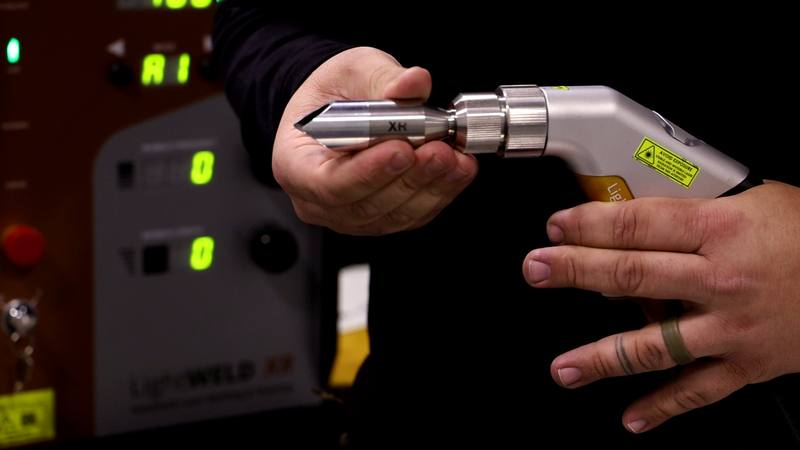
Why This Matters More Than the Number on the Scale
A handheld laser welder gets picked up, put down, handed between operators, and occasionally dropped — that's just shop floor reality, not a hypothetical. A design that trades a few hundred grams of weight for field-replaceable optics, adjustable beam control, active weld-quality monitoring, and drop-safe triggering isn't heavier because it's behind on engineering. It's heavier because it's carrying capability the lighter competitors left out to hit a number on a spec sheet.
We see the other side of this in our workshop regularly — sealed competitor units that come in after a knock with no local repair path, compared against LightWELD units where a field technician swaps the damaged part and the machine is back welding the same day. If you want the full picture on serviceability and total cost of ownership, our LightWELD vs Chinese laser welder comparison covers it in detail.
See the Difference Yourself
If you want to see the difference side by side, come run a demo with us at Hallam — bring your own material, and feel the handle for yourself rather than taking a spec sheet's word for it.